
Lycoming County Active Warrants
The key local warrant source is the Lycoming County Sheriff's Office Warrants Division. That division is tied to civil process, fugitives, sheriff transport, and active warrant information. The research also identifies a sheriff-published active warrant list hosted through CRIMEWATCH. Because a public list is only one channel, any Lycoming County warrant record should be checked against the issuing court or sheriff before a person acts on it.
The Warrants Division warns people not to attempt to apprehend a recognized fugitive. If a fugitive is seen, the published instruction is to call the Lycoming County Communications Center at 570-329-4066. The sheriff phone for warrant contact is (570) 327-2280. The same research says law-enforcement personnel must verify active warrants through the communications center, which is a useful reminder that a web entry is not the final enforcement check.
The official sheriff warrants page is the source for the local warrant division image used here.
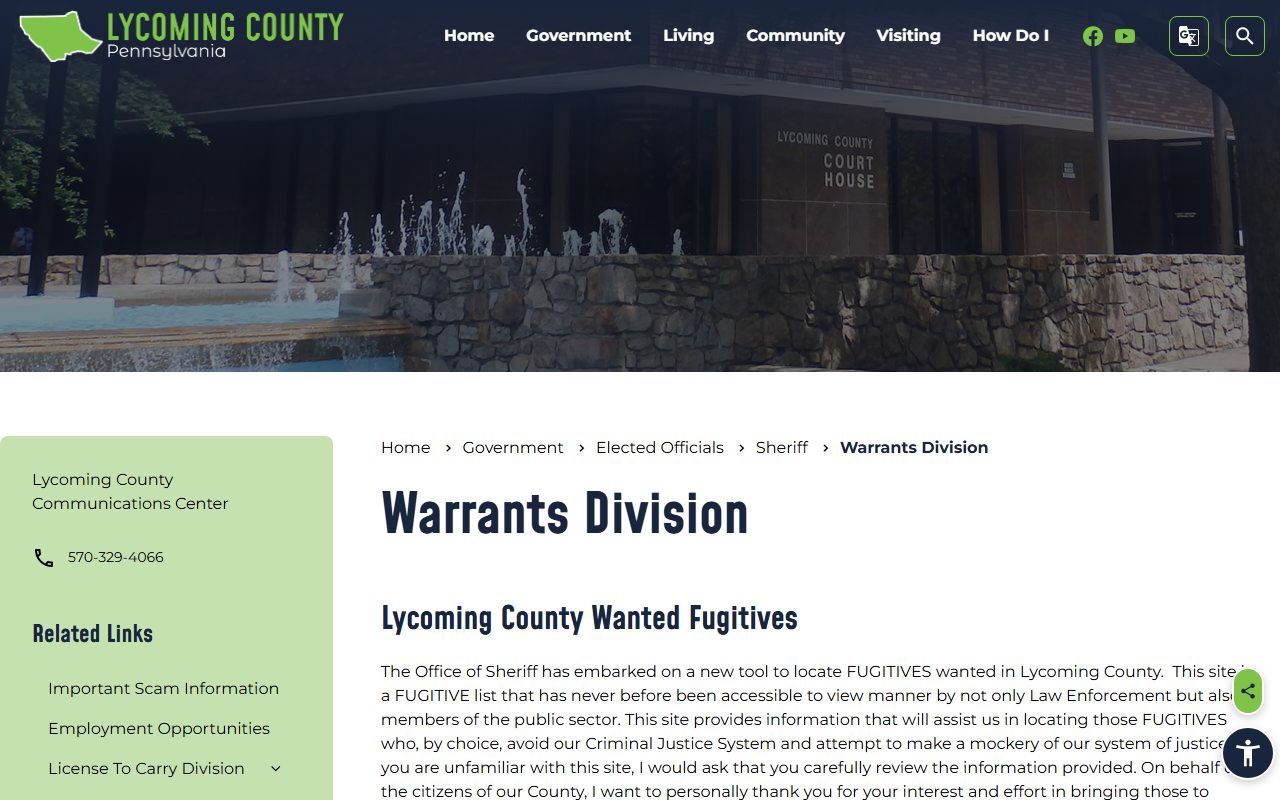
The image reflects the local sheriff channel that should be paired with court docket checks before any Lycoming County warrant is treated as current.
Search Lycoming County Warrants
The public online path is the sheriff's CRIMEWATCH warrant page. It can show wanted-person entries and agency details where the sheriff has published them. It should be used with care because some warrants are sealed, some are recalled, and some bench warrants may be visible first through court docket activity rather than a sheriff listing. A name search also can return people with similar names, so the match should be checked by the court, docket number, case facts, or agency contact before a decision is made.
- Open the sheriff warrant list hosted on CRIMEWATCH and search by name or keyword.
- Review the agency, headline, charge summary, date, photograph if posted, and tip controls.
- Search the UJS Case Search for Lycoming County criminal or Magisterial District Court dockets tied to the same person.
- Call the sheriff, the issuing court, or counsel when the record appears to involve an active criminal matter.
- Keep proof of any recall order, bail action, payment, or new court date after the warrant is handled.
| Field Label | Type | Required | Notes |
|---|---|---|---|
| Search | Text | No | Name or keyword search of public warrant listings. |
| Filter or agency | Control | No | CRIMEWATCH pages may allow agency or content filtering. |
| Sort | Control | No | Results may sort by newest or relevance depending on interface. |
| Warrant item link | Link | Not applicable | Opens a public detail page where the sheriff has posted one. |
Lycoming County Warrant Record Fields
A public warrant listing is usually shorter than a full court file. It may show enough to identify the person and agency, but it does not replace the docket sheet, the warrant order, or direct confirmation. Court dockets can add the case number, judge or issuing authority, bail status, failure-to-appear entry, charge disposition, and later recall or clearance notes. For criminal warrant context, the full case file belongs with Lycoming County criminal court records.
| Field | What It Shows |
|---|---|
| Name | The wanted person named in the sheriff or court listing. |
| Agency | Usually Lycoming County Sheriff's Office when published by the sheriff. |
| Headline or incident | A short warrant or incident label. |
| Charge summary | Offense text where the agency makes it public. |
| Date posted | The post or update date, not always the warrant issue date. |
| Photo or tip controls | May appear when the agency publishes them through CRIMEWATCH. |
Note: A posted date is not the same as proof that the warrant was still active at the time of a later search.
Lycoming County Warrant Types
Warrants can come from different parts of the court system. Magisterial District Courts handle many preliminary criminal events, traffic citations, summary cases, and failure-to-appear matters. The Court of Common Pleas handles felony cases, major criminal proceedings, probation violations, and other county-level matters. A sheriff list may show a public fugitive entry, while the docket sheet explains the underlying case and status.
- Arrest warrant: A court order authorizing an arrest in a criminal matter.
- Bench warrant: A judge's order often tied to failure to appear, noncompliance, or a court status problem.
- Search warrant: A court order for a place or item, often not public while an investigation is active.
- Failure-to-appear warrant: A warrant tied to missing a required hearing, plea, payment, or compliance date.
- Probation-related warrant: A warrant or detainer connected to alleged supervision violations.
Important: Do not use a Lycoming County warrant record to confront someone or attempt detention.
Lycoming County Warrant Access Channels
Online search is only the first channel. The access-channel sweep in the research points to the sheriff warrant list, UJS docket sheets, Magisterial District Court records, phone contact with the sheriff or court, in-person resolution, and Right-to-Know requests for non-confidential sheriff administrative records. Pennsylvania does not offer a simple public statewide warrant database that replaces county sheriff and court checks.
The issuing authority matters because the next step changes by source. A warrant connected to a missed traffic hearing may route through a Magisterial District Court. A warrant tied to a felony case or probation violation may route through the Court of Common Pleas, the Clerk of Courts, probation, or counsel. A sheriff entry can help identify the public safety channel, but the court docket explains why the warrant exists and which judge or office can clear it.
| Channel | Best Use | Limit |
|---|---|---|
| Sheriff CRIMEWATCH list | Public active warrant entries posted by the sheriff. | May lag or omit sealed matters. |
| UJS Case Search | Bench warrant, bail, case status, and docket history clues. | Not a full warrant document repository. |
| Magisterial District Court | Traffic, summary, preliminary criminal, and issuing-authority matters. | Must check the right district or docket. |
| Sheriff or court phone contact | Verification and next-step instructions. | Staff may not give legal advice. |
| Right-to-Know channel | Administrative sheriff records where public. | Does not open sealed warrants or active investigative material. |
Resolve a Lycoming County Warrant
A person who may have a warrant should first identify the source. The docket may point to a missed Magisterial District Court hearing, a Common Pleas criminal case, a bail condition, a probation matter, or a traffic citation that was ignored. Counsel can help decide whether to contact the court, arrange surrender, request a hearing, address bail, or file a motion. Going to the wrong office can waste time and may leave the warrant active.
The practical sequence is to confirm the warrant, identify the docket, ask whether bail is set or a judge appearance is required, arrange surrender or court appearance if directed, and keep proof of the result. After a warrant is recalled, status should be checked in both court and sheriff systems. A payment receipt or hearing notice is useful, but the court order or docket update is the stronger proof.
Note: A warrant tied to new charges may also affect custody status, so the inmate and court-charge records should be checked together.
Restricted Lycoming County Warrants
Not all warrant information is public. Sealed warrants, juvenile matters, confidential investigative material, some search warrants, mental-health related records, and victim-sensitive information may be withheld or redacted. Pennsylvania's judiciary public-records guidance and the Case Records Public Access Policy control court-record access, while the Office of Open Records channel is used for many county administrative records.
Expunged or sealed criminal records also can limit what appears in a public search. Pennsylvania law, including 18 Pa.C.S. Section 9122, may remove eligible record information from public access only after the right process and court order. Juvenile court records are restricted under 42 Pa.C.S. Section 6307. A missing public record is not proof that no sealed or confidential court action exists.
Search warrants deserve special care. They may involve active investigations, sealed affidavits, or property returns that are not posted in a public warrant list. If a court later unseals part of the file, access still may be limited to the docket, order, or redacted material rather than the full investigative record.