
Lycoming County Arrest Records and Court Charges
Arrest records begin with law enforcement. They may identify the person arrested, the arresting agency, booking or custody status, and the event that led to detention. Court charges begin when the case enters the court system through a complaint, information, or other charging record. In Lycoming County, those charge records may appear first in Magisterial District Court and later in the Court of Common Pleas if the case moves forward.
The arrest side and the charge side answer different questions. The custody side can show whether a person is held in the county prison or appears in VINE or state custody tools. The court side shows the filed charges, grading, statute citations, plea, disposition, and sentence. Current custody should be checked through jail and VINE sources, while the full case file belongs with Lycoming County criminal court records.
Find Lycoming County Arrest Records and Charges
For court charges after arrest, start with the Pennsylvania UJS Case Search. Use Magisterial District Court for preliminary criminal proceedings, summary matters, and early case activity. Use Common Pleas for felony and county-level criminal case records after the matter is held for court or otherwise docketed there. If a person is in custody, pair the docket with Lycoming County Prison, VINE, or PA DOC search channels.
- Search UJS by defendant name or docket number and filter to Lycoming County.
- Check Magisterial District Court dockets for the first complaint, preliminary arraignment, bail, or preliminary hearing.
- Check Common Pleas dockets for formal information counts, motions, plea, disposition, sentence, and appeal activity.
- Read each charge line separately because charges can be amended, reduced, dismissed, withdrawn, or resolved in different ways.
- Use the courthouse request form when a certified charge record or full copy is needed from the Clerk of Courts.
Warrant and custody channels can add context, but they do not replace the court docket. A sheriff warrant listing may indicate a wanted person, and VINE may indicate custody status, while the court record explains the charge and court outcome.
Charges After Arrest Documents
Charges after arrest are recorded through documents that start or formalize the criminal case. Pennsylvania practice commonly involves a criminal complaint at the lower-court stage and a criminal information at the Common Pleas stage. Indictment is included here as a general charging concept, but the local Lycoming County research points most directly to complaints, preliminary proceedings, and prosecutor-filed informations.
| Complaint | Information | Indictment | |
|---|---|---|---|
| Filed by | Police or prosecution channel. | District Attorney or prosecutor. | Grand jury process where used. |
| Local role | Often starts the MDJ criminal docket after arrest or summons. | Formalizes counts in Common Pleas after preliminary proceedings. | Less central to the researched county access path. |
| What it shows | Alleged offense, complaint number, probable cause, and charging details where public. | Counts, grading, statute citations, and prosecutor-filed charges. | Formal accusation returned through the grand jury process. |
| Where to search | Magisterial District Court docket sheets. | Common Pleas criminal docket sheets and Clerk of Courts files. | Appropriate court docket if one exists publicly. |
Lycoming County Charge Status
Charge status can change many times. An original charge may be held for court, amended to a different grade, reduced in plea talks, dismissed at a hearing, withdrawn, or resolved by guilty plea or trial verdict. Do not read the first charge line as the final result. The disposition field and sentence entries are the key parts of the court charge record.
| Status | What It Means |
|---|---|
| Pending | The charge remains open and has not reached final disposition. |
| Held for court | The lower-court stage sent the case to the Court of Common Pleas for further proceedings. |
| Amended or reduced | The charge changed by count, grade, statute, or negotiated resolution. |
| Dismissed or withdrawn | The charge did not proceed, though other counts may remain active or disposed. |
| Nolle prosequi | The prosecution declined to continue the charge, subject to the court record and order. |
The Pennsylvania Megan's Law registry is a separate state police system, not a general Lycoming County arrest records database.
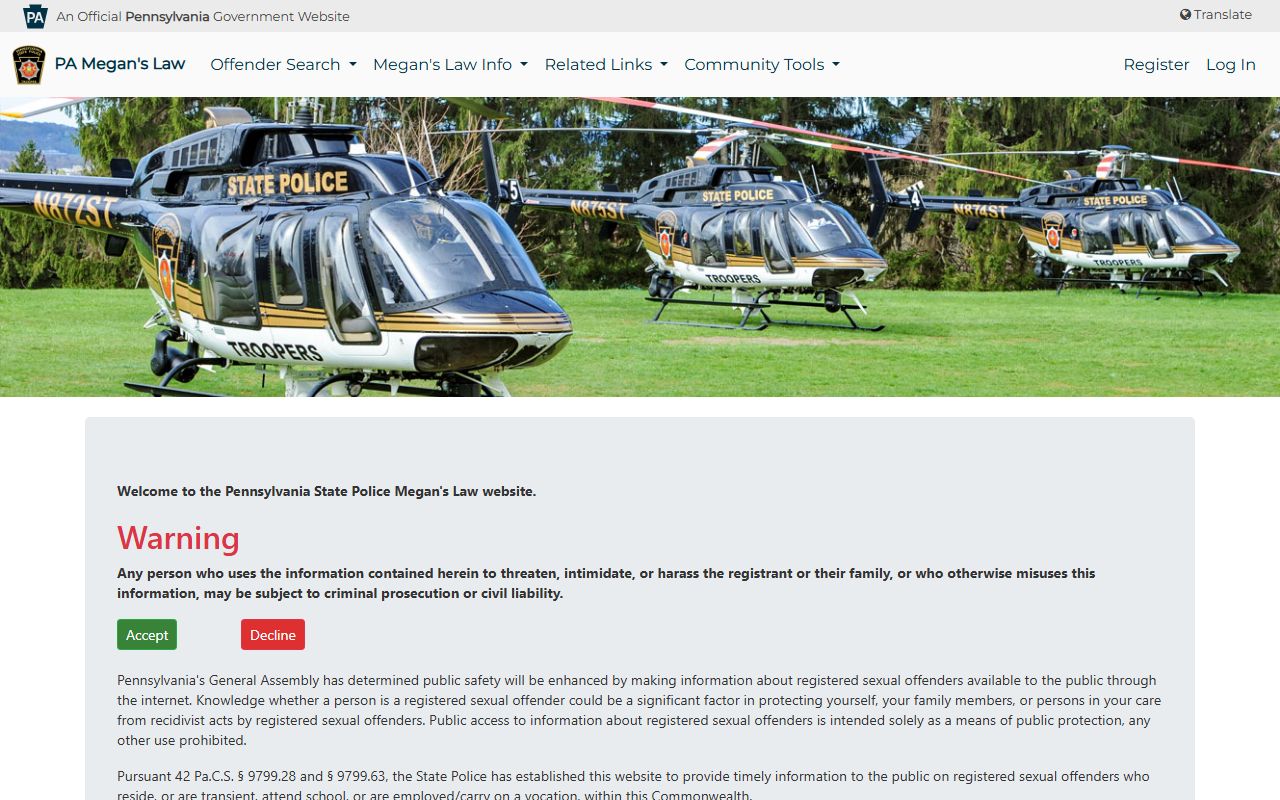
Registry results should not be used as a substitute for reading charge, conviction, and sentencing entries in the court docket.
Lycoming County Charges vs Convictions
Being charged is not the same as being convicted. A Lycoming County arrest may lead to several court charges, and each charge can end differently. Some charges are amended or dismissed. Some result in guilty pleas or verdicts. Some remain pending for a time. The conviction question depends on the disposition, not just the fact that an arrest or complaint occurred.
| Charge | Conviction | |
|---|---|---|
| Stage | An accusation filed in court after arrest, summons, or complaint. | A final result based on plea, verdict, or qualifying adjudication. |
| Proof level | May begin with probable cause and prosecutor review. | Requires a guilty plea, verdict, or court finding. |
| Docket check | Read status, amendments, dismissals, and held-for-court entries. | Read disposition, sentence, costs, restitution, probation, and appeal entries. |
Charge Codes and Severity
Court charge records often list statute citations, offense descriptions, grading, and counts. A single arrest can lead to multiple counts. A case can include felony, misdemeanor, summary, traffic, or ordinance-related matters depending on the conduct and court level. In Pennsylvania, felony and major misdemeanor charges may move beyond the MDJ stage, while summary or traffic matters can remain at the lower court level.
Charge codes should be read with the docket stage. An MDJ complaint may show early allegations, while a Common Pleas criminal information can show prosecutor-filed counts after preliminary proceedings. If the docket lists a plea or disposition beside each count, each line should be read separately. One count may be guilty, another dismissed, and another withdrawn.
Statewide and Federal Charge Sources
Pennsylvania does not provide one simple public statewide arrest-record database that replaces Lycoming County court dockets. UJS is the main statewide court docket search. VINE helps with custody notification. The PA DOC inmate locator covers state-prison custody. The Megan's Law registry covers a specific category of sex-offender registration and should not be treated as a full criminal-history source.
Federal cases are separate. Lycoming County is in the Middle District of Pennsylvania for federal court. A federal prosecution may involve the U.S. Attorney's Office and federal court records rather than Lycoming County Common Pleas records.
The U.S. Attorney's Office for the Middle District of Pennsylvania is the federal prosecution source for cases in the district.
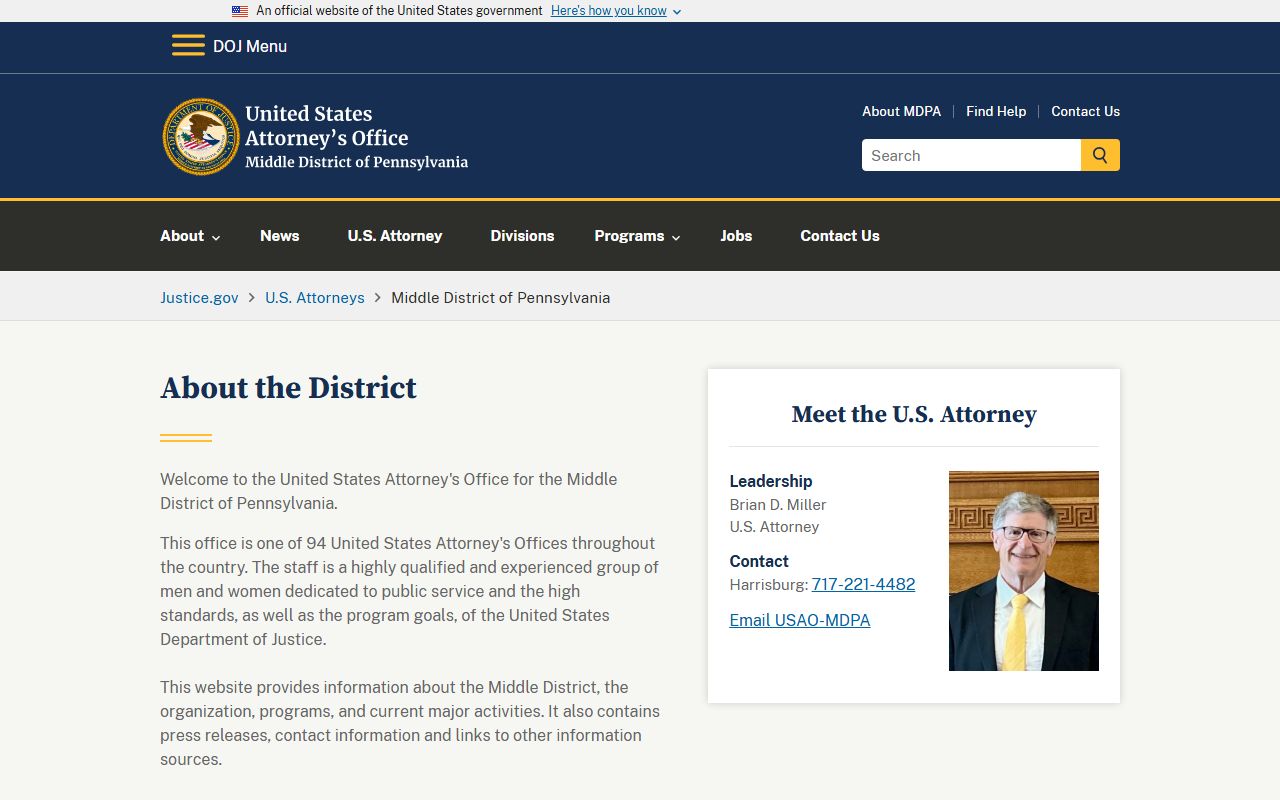
County charges, state registry records, and federal prosecution records should be searched in their own systems because they answer different questions.
Lycoming County Sealed Charge Records
Arrest records and charge records can be limited by juvenile law, sealing, expungement, or court order. Pennsylvania's expungement statute, 18 Pa.C.S. § 9122, is a key source for eligible criminal-history relief. Juvenile records are restricted under 42 Pa.C.S. § 6307. Not every old charge, dismissal, or arrest qualifies for removal from public access.
| Sealed | Expunged | |
|---|---|---|
| Public search | Record is hidden or limited for ordinary public users. | Record is removed or treated as unavailable as ordered. |
| Effect | Some court or agency access can remain. | Removal depends on the statute, order, and agency instructions. |
| Local step | File in the court that handled the case if eligible. | Use docket, disposition, sentence-completion, and charge identifiers. |
Restricted Lycoming County Charge Records
Restricted charge records include juvenile matters, sealed cases, expunged matters, mental-health proceedings, adoption-related files, and records with protected victim, child, medical, or financial information. Family-sensitive or abuse-related records may have public docket components while specific addresses, allegations, and attachments are withheld. A missing search result is not proof that no arrest or charge ever existed.
The best access chain is to search UJS, check the court level, review custody or warrant sources only where relevant, and contact the correct office for copies. The Clerk of Courts handles criminal Common Pleas record requests. Magisterial District Court records should be checked separately for preliminary, summary, traffic, and lower-court criminal matters.
Important: Arrest and charge records are not consumer reports and should not be used for FCRA-regulated decisions.